 The
The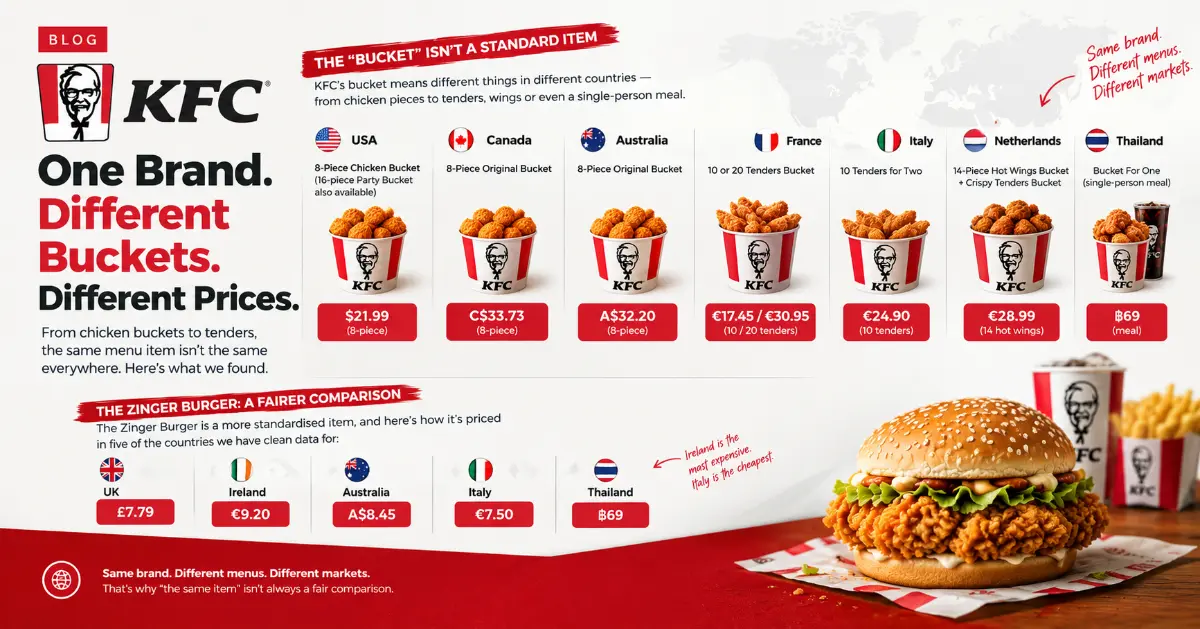
The short answer
An 8-piece KFC bucket costs about $22 to $24 in the US, Canada and Australia once you convert the currencies. It's cheaper in Mexico and Nigeria. In much of Europe, a KFC "bucket" usually means tenders or wings, not bone-in chicken, so there's no clean like-for-like price.
That's the surprise in this comparison. The bucket is KFC's best-known product, but it isn't a fixed item the way a Big Mac is. The name stays the same while what's inside changes from country to country.
How much is an 8-piece KFC bucket in each country?
These are the 8-piece buckets on our KFC lists, converted to US dollars:
| Country | On the menu as | Local price | In US dollars | Per piece |
|---|---|---|---|---|
| US | 8 pc. Chicken Only | $22.79 | $22.79 | $2.85 |
| Canada | 8pc Original Bucket | C$33.73 | $23.85 | $2.98 |
| Australia | 8pc Original Bucket | A$32.20 | $22.64 | $2.83 |
| Mexico | Bucket Clásico de 8 Piezas | MX$309 | $17.46 | $2.18 |
| Nigeria | 8-Piece Bucket | ₦16,300 | $12.26 | $1.53 |
Dollar figures use exchange rates from 25–26 September 2026.
Read the table with two caveats. First, the names don't always tell us what comes with the chicken. Second, the US price comes from KFC's delivery menu, and the source says in-store prices are often lower.
Why do the US, Canada and Australia come out so close?
In local money, they look far apart. C$33.73 and A$32.20 sound much dearer than $22.79. Convert them, though, and the three sit within about $1.20 of each other.
That's a useful lesson for any price comparison. A bigger number on a foreign menu doesn't mean a higher price. Our currency converter does the sum for you.
Is Mexico's bucket really that cheap?
Partly. Mexico's Bucket Clásico looks like it comes with extras. On the same list, six pieces on their own (solas) cost MX$199, while the six-piece Clásico costs MX$249.
So the fairest Mexican figure is the plain six-piece bucket. That works out at about $1.87 a piece, still well below the US, Canada or Australia.
Do bigger buckets save money?
Not everywhere. Here's the cost per piece for the larger buckets on our lists:
- US, 16 pieces ($40.79): $2.55 a piece, down from $2.85 for 8
- Australia, 16 pieces (A$63.02): $2.77 a piece, barely less than $2.83 for 8
- Canada, 16 pieces (C$74.89): $3.31 a piece, more than the 8-piece at $2.98
- Mexico, 18 pieces (MX$599): $1.88 a piece
- Nigeria, 12 pieces (₦24,600): $1.54 a piece
The Canadian result is the odd one. On our list, two 8-piece buckets (C$67.46) cost less than one 16-piece (C$74.89). The bigger bucket may include extras our source doesn't show, so check the app before you order. But don't assume the biggest bucket is the best deal.
What does a "bucket" mean in Europe and Asia?
Outside North America, the word often covers something quite different:
- France: sharing meals of tenders or wings, with a 10-tender meal at €19.45 and a 20-tender meal at €34.85
- Italy: a "Bucket per 2" of 10 tenders for €24.90, about $28.39
- Netherlands: a bucket meal of 14 Hot Wings, 10 Crispy Tenders or 5 Original pieces with sides at €24.99, about $28.50, and a meal with twice as much chicken at €44.49
- Germany: a Kentucky Bucket at €27.99 and an Original Bucket at €25.99, though our source doesn't give the number of pieces
- Thailand: a "Bucket For One" at ฿69, a single-person meal rather than a sharing bucket
The Dutch prices come from KFC's own ordering site for its Amsterdam Damrak restaurant. The Thai prices come from a 2025 listing that we haven't been able to re-check yet.
Is the Zinger burger a better comparison?
It's closer, because the Zinger is broadly the same spicy chicken burger wherever it's sold. Here's what it costs on our lists:
Ireland is the dearest of the four and Thailand is by far the cheapest. The UK figure comes from a central London delivery listing, which can be higher than a typical in-store price. The US list doesn't include a Zinger. Its nearest item is the Classic Chicken Sandwich at $5.99.
Tips for getting the best value at KFC
- Compare the price per piece, not per bucket. It's the only fair way to compare sizes.
- Check whether two smaller buckets beat one big one. On our Canadian list, they do.
- Order in store or for pickup if you can. Delivery menus often cost more, and the app adds fees. Our delivery markup calculator shows the difference.
- In the US and Canada, add sales tax. Menu prices there exclude tax, and our sales tax calculator adds it for you.
Where do these numbers come from?
Every price comes from the KFC menu page for that country on our site, and each page shows its source and when we last checked it. We re-sourced the US, French and German lists in October 2026, replacing earlier figures that their source had labelled as estimates. You can see every country side by side on our KFC page, and our methodology explains how we check prices.