 The
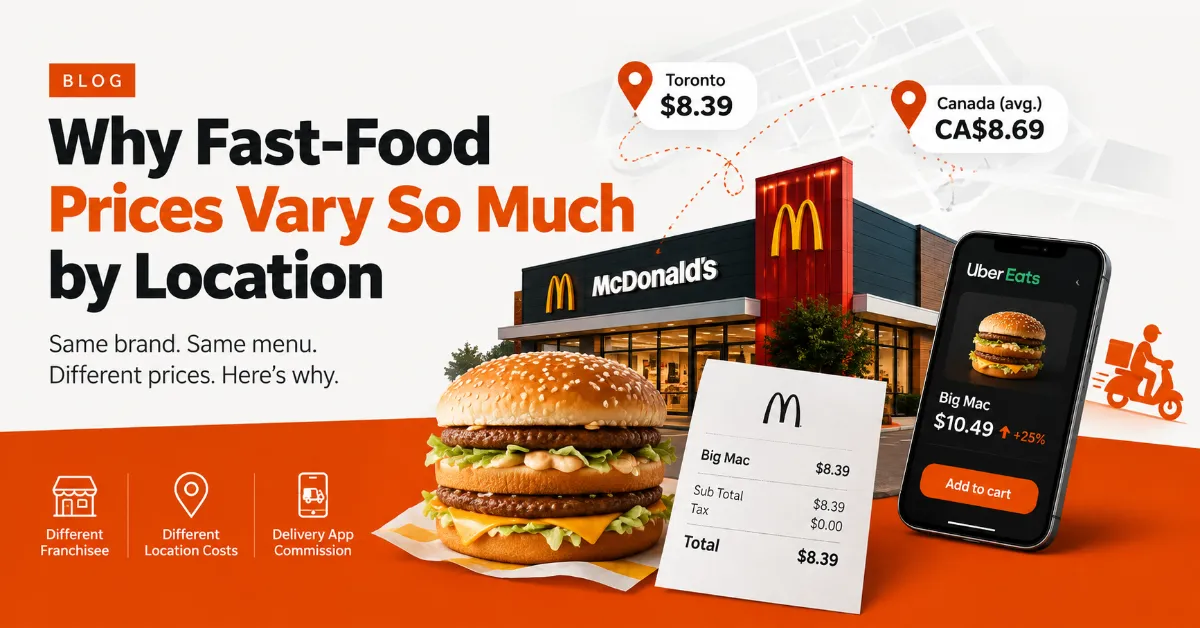
Why do McDonald's prices differ between locations?
Because most McDonald's restaurants are run by franchisees, and franchisees set their own prices. McDonald's owns the brand and the recipes, but about 95% of its restaurants worldwide are owned and operated by independent business owners. Each one prices its menu to cover its own rent, wages and local competition.
The same is true of most big chains. KFC is 99% franchised, according to its parent company, Yum! Brands. Subway says all its restaurants are independently owned, and that its franchisees set their own prices.
What makes one branch dearer than another?
Mostly costs that differ from street to street:
- Rent. A restaurant on a busy high street or in a shopping centre pays far more than one on a retail park.
- Wages. Minimum wages differ between US states and cities, and staff are harder to hire in some places.
- Captive locations. Airports, railway stations and motorway services often charge more, because there's less competition and the rent is high.
- Local competition. A branch with three rival chains next door has less room to raise prices.
So a Big Mac in a city centre and one in a small-town retail park can cost noticeably different amounts, even within the same chain and the same country.
Are delivery apps more expensive than ordering in store?
Usually, yes. Delivery platforms charge restaurants a commission on each order, often somewhere between 15% and 30%. Many restaurants cover it by listing higher prices in the app.
One study puts a number on it. An analysis of 25 popular US restaurants by Gordon Haskett Research Advisors, reported by CNBC in July 2024, found app prices averaged about 20% more than dining in. That's before delivery and service fees, which add more on top.
This matters for our data too. Some of the sources we use take prices from a chain's delivery menu, and they say in-store prices are often lower. Where we know that, the menu page says so. Our delivery markup calculator shows the real extra cost of any order.
Does tax change the price as well?
In the US and Canada, yes. Menu prices there are before sales tax, and the rate depends on the state, county and city. A $5.99 Big Mac costs $5.99 in Oregon, which has no sales tax, but about $6.48 in Texas and $6.60 in Louisiana at average rates.
So two branches of the same chain can charge the same menu price and still give you different totals. Our sales tax calculator works out the total for any state. In most other countries we cover, the menu price already includes tax.
How should you read the prices on our site?
As a fair guide to what a chain charges in a country, not a promise about your nearest branch. We take each country's prices from the best public source we can find, and we note where they came from. Sometimes that's a menu-price site covering the whole country. Sometimes it's one named branch, such as a KFC in central London or a McDonald's in Envigado, near Medellín.
That means your local price could be a little higher or lower. Each menu page shows when we last checked it, and how we verify menu prices explains our sources in more detail.
How can you find the exact price at your branch?
Use the chain's own app or website and choose your restaurant. It shows that branch's current prices, and the app often has deals you won't see on the menu board. For a quick comparison across chains or countries, our menu pages and the Fast-Food Price Index are the faster way to get a sense of what things cost.
Does the same burger cost different amounts in different countries?
Yes, and by much more than between branches. On our lists, a Big Mac costs about $5.55 in the UK and $8.32 in Ireland once you convert the currencies. Exchange rates, taxes, wages and local pricing all play a part. Our guide to Big Mac prices around the world has the full comparison.